
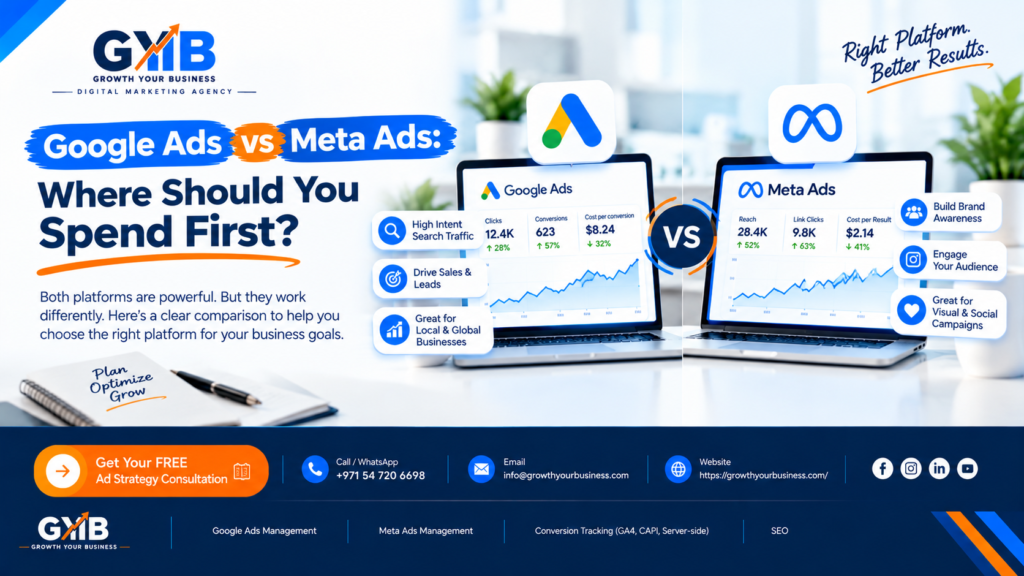
Google Ads vs Meta Ads: Where Should You Spend First?
In the Google Ads vs Meta Ads decision, start with Google Ads if people actively search for what you sell (plumbers, lawyers, software, anything with clear buying intent). Start with Meta Ads if your product is visual, impulse-driven, or needs to be discovered rather than searched for (fashion, home decor, new consumer products). If you’re genuinely unsure, Google Ads is usually the safer first move for most service-based and B2B businesses, since it captures demand that already exists, rather than trying to create it. Most businesses with a healthy budget eventually run both, but when funds are limited, matching the platform to how your customers actually shop matters more than any general rule.
The core difference: intent vs. discovery
This is the single most important concept for deciding where to spend first.
Google Ads captures existing intent. Someone searches “emergency plumber near me” or “best project management software,” and your ad appears because they’re already looking. You’re meeting a need that already exists in that moment.
Meta Ads creates discovery. Someone’s scrolling Instagram or Facebook, not actively looking to buy anything, and your ad interrupts that scroll with something they didn’t know they wanted yet. You’re generating a need, not meeting an existing one.
Neither is “better,” they solve fundamentally different problems. The question is which problem your business actually has right now.
When to start with Google Ads
Google Ads tends to perform better first for:
- Service businesses with clear search intent: plumbers, lawyers, dentists, contractors, consultants. People actively search when they need you.
- B2B and software: buyers research and compare before purchasing, which plays directly into Google’s search-based model.
- High-consideration purchases: anything where people research before buying (insurance, real estate, financial services) benefits from being present at the moment of that research.
- Businesses with limited brand awareness: if nobody knows your brand yet, Google Ads lets you capture people already searching for your category, without needing to build awareness first.
The trade-off: Google Ads costs per click are often higher in competitive industries, legal and insurance keywords can run well into double digits per click. You’re paying for proven intent, which commands a premium.
When to start with Meta Ads
Meta Ads tends to perform better first for:
- Visual products: fashion, home goods, food, anything that sells itself through imagery.
- Impulse or low-consideration purchases: products people buy on a whim rather than after researching, where interrupting a scroll works better than waiting for a search.
- New or innovative products: if nobody is searching for your product yet because it’s new, Google Ads has nothing to capture, Meta can introduce the concept directly.
- Strong brand storytelling: businesses with compelling visuals or a founder story that resonates emotionally tend to perform well on Meta’s discovery-based format.
The trade-off: Meta Ads performance has become more dependent on accurate tracking since iOS privacy changes limited browser-based data. Without the Meta Conversions API properly configured, you may be optimizing against incomplete conversion data.
Before you decide between Google Ads vs Meta Ads for your business, ask yourself these three questions:
A simple framework: ask these three questions
- Does my customer already know they need this, and would they search for it? Yes → lean Google Ads. No → lean Meta Ads.
- Is my product primarily visual, or does it need to be seen to be understood? Yes → lean Meta Ads. No (it’s more functional or service-based) → lean Google Ads.
- What’s my price point and consideration time? High-consideration, researched purchases favor Google Ads; impulse-friendly, lower-consideration purchases favor Meta Ads.
If your answers point in different directions, that’s often a sign your business could actually benefit from both platforms working together, more on that below.
What about using both?
Many successful US and UK businesses don’t choose one over the other permanently, they sequence them or run both with clear roles:
- Google Ads to capture demand, Meta Ads to build it. Use Meta to introduce your brand to new audiences, then Google Ads to capture people who later search for you by name or category.
- Retargeting on Meta after Google traffic. Someone searches on Google, visits your site, doesn’t convert, then sees a Meta retargeting ad reminding them to come back. This combination often outperforms either platform alone.
- Budget split based on funnel stage. Top-of-funnel awareness budget toward Meta, bottom-of-funnel conversion budget toward Google.
The honest answer for most growing businesses: start with whichever platform matches your immediate need above, prove it works, then add the second platform once you have the budget and tracking in place to manage both well.
Don’t skip tracking, regardless of which you choose
Whichever platform you start with, the same rule applies: you can’t optimize what you can’t measure accurately. Google Ads needs GA4 properly linked; Meta Ads needs the Conversions API running alongside the Pixel. Starting a platform without this in place means you’ll be making decisions on incomplete data from day one. See our guides on GA4 setup and server-side tracking before launching either platform.
How Growth Your Business (GYB) helps you decide
We don’t default every client to the same platform. During your free audit, we look at your specific business, product, and customer behavior to recommend where your first dollars should go, then set up full conversion tracking before a single campaign launches, whether that’s Google Advertising, Meta Ads, or both.
FAQ
Should I start with Google Ads or Meta Ads on a limited budget? It depends on your business. Start with Google Ads if customers actively search for what you offer. Start with Meta Ads if your product is visual, impulse-driven, or needs to be discovered rather than searched for.
Which is cheaper, Google Ads or Meta Ads? It varies by industry. Meta Ads often has a lower cost per click, but Google Ads can deliver higher-intent traffic that converts at a higher rate, making the true cost per customer closer than the cost per click alone suggests.
Can I run Google Ads and Meta Ads at the same time? Yes, and many businesses eventually do, often using Google Ads to capture existing demand and Meta Ads to build brand awareness and retarget previous website visitors.
Is Meta Ads better for B2B businesses? Generally, Google Ads performs better for B2B, since B2B buyers typically research and search actively before purchasing, which aligns with Google’s intent-based model. Meta Ads can still work for B2B brand awareness and LinkedIn-style audience targeting.
Why does my Meta Ads performance look worse than expected? Incomplete conversion tracking is a common cause. iOS privacy restrictions limit what the Meta Pixel can see on its own, so performance can look worse than reality without the Conversions API configured alongside it.
Does Google Ads work for new, unknown brands? Yes, if people are already searching for your product category, even if they don’t know your specific brand yet. If nobody is searching for your category at all because it’s a new type of product, Meta Ads may be more effective for initial discovery.
How do I know which platform is working better for my business? Compare cost per conversion and conversion rate (not just cost per click) across both platforms, using accurate tracking (GA4 and the Conversions API) so you’re comparing real results, not incomplete data.
Not sure where your first ad dollars should go? Get a free audit and we’ll recommend the right starting point for your specific business. Call or WhatsApp +971 54 720 6698.