
PPC Agency Cost in the USA (2026): What You’ll Actually Pay
Quick answer for PPC Agency Cost in the USA
Most PPC agencies in the USA charge either a flat monthly retainer of $1,500 to $10,000, or 10% to 20% of your monthly ad spend, with the percentage dropping as your budget grows. Small businesses spending under $5,000 a month on ads typically pay 15% to 25% in management fees, while larger accounts spending $50,000 or more often negotiate down to 5% to 12%. There’s no single “correct” number, the right model depends on your ad budget, your industry, and how complex your tracking setup needs to be.
Below, we break down exactly how these pricing models work, what actually drives the cost up or down, and how to compare quotes without getting confused by hidden fees.
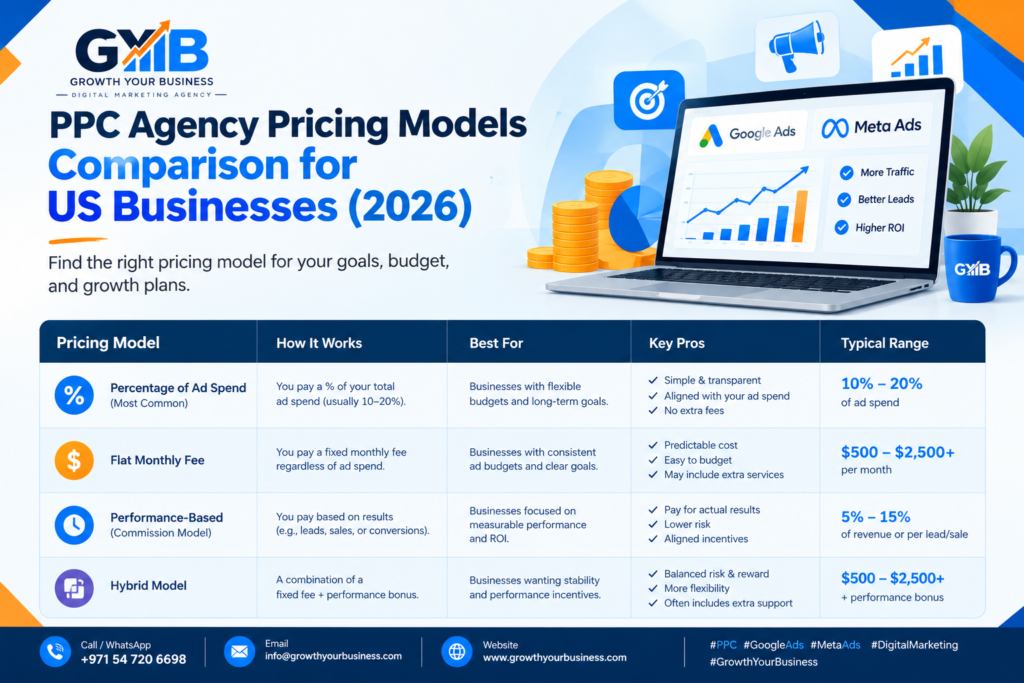
The four ways PPC agencies charge
1. Percentage of ad spend
This is the most common model. The agency takes a cut of whatever you spend on the ad platforms (Google, Meta, Microsoft, etc.), separate from the ad spend itself.
Typical rates by monthly spend level:
| Monthly ad spend | Typical management fee |
|---|---|
| Under $5,000 | 20% to 25% |
| $5,000 to $20,000 | 15% to 20% |
| $20,000 to $100,000 | 10% to 15% |
| Above $100,000 | Custom, often under 10% |
Example: If you spend $10,000/month on Google Ads and your agency charges 15%, you’d pay a $1,500/month management fee on top of the $10,000 ad spend, for a total of $11,500/month.
The upside of this model is that it scales naturally with your business. The downside is a built-in conflict of interest: an agency earning a percentage of spend has less incentive to tell you when you should actually spend less.
2. Flat monthly retainer
A fixed fee regardless of how much you spend on ads. Retainers commonly run $750 to $5,000+ per month, depending on account complexity.
This model removes the incentive problem above, since the agency’s income doesn’t change whether your spend goes up or down. It’s a good fit if you want predictable costs and plan to grow your ad budget over time without your management fee growing at the same rate.
3. Hybrid pricing
A smaller base fee (say $500 to $1,000) plus a reduced percentage of spend above a certain threshold. This has become more common because it balances the agency’s need for stable income with some upside as your account grows, while keeping the incentive conflict smaller than a pure percentage model.
4. Performance-based pricing
You pay based on results, leads, sales, or a defined cost-per-acquisition target. This sounds appealing but works best for businesses with clean attribution and high-value conversions. If your results are already solid, some performance-based agencies have less incentive to keep optimizing once they’ve hit their payout threshold, so it’s worth asking directly how the incentive structure works before signing on.
What actually drives the price up or down
- Your ad spend level. Higher spend generally means more ad groups, more testing, and more oversight, so agencies price accordingly, even under a flat retainer.
- Number of platforms. Running Google Ads only costs less to manage than running Google Ads, Meta Ads, and Microsoft Ads together.
- Tracking complexity. If your conversion tracking (GA4, Conversions API, server-side tracking) isn’t set up correctly, expect a setup fee on top of the monthly retainer. Broken tracking on a smaller account can genuinely take more agency time to fix than managing a larger, well-tracked one.
- Industry. Competitive, high-CPC industries (legal, home services, finance) generally require more active bid and budget management than lower-competition niches.
- Reporting expectations. Custom dashboards (like Looker Studio) and regular strategy calls add time that some agencies bake into a “premium” tier rather than the base fee.
Ad spend vs. management fee: know the difference
This trips up a lot of first-time buyers. Ad spend is the money paid directly to Google, Meta, or Microsoft to actually run your ads. Management fee is what you pay the agency to plan, build, and optimize those campaigns. They are two separate line items, and a good agency will always show both clearly rather than bundling them into one number that’s hard to compare against competitors.
When you’re comparing quotes, always ask: “What’s the total, management fee plus expected ad spend, and what results have you delivered at a similar spend level?”
Is a PPC agency worth the cost?
For context, Google reports that businesses generate an average of $2 in revenue for every $1 spent on Google Ads, and well-optimized accounts can perform meaningfully better than that baseline. That return depends heavily on execution, which is exactly what a management fee is paying for: someone actively watching bids, testing ad copy, cutting wasted spend, and making sure your conversion tracking is actually accurate.
If your business spends more than roughly $3,000 to $5,000 a month on ads, or you don’t have someone in-house who can dedicate real time to account management, a PPC agency’s fee is usually easy to justify against the wasted spend of an unmanaged account.
Questions to ask before signing with any PPC agency
- What’s your pricing model, and what’s included at that price?
- Is conversion tracking setup included, or is it a separate one-time fee?
- What happens to the fee if I increase or decrease my ad spend?
- Can I see an example of your reporting?
- Who will actually be managing my account day to day?
If a proposal can’t answer these clearly in writing, that’s a bigger red flag than the price itself.
How Growth Your Business (GYB) prices PPC management
At GYB, we use a hybrid model: a base retainer covering strategy, Google Advertising and Meta Ads management, and full conversion tracking setup, with transparent reporting built in from day one. There’s no guesswork about what’s included, and no separate surprise fee for GA4 or Conversions API setup, we build that in before your campaigns launch. Contact us for a free audit and a straight answer on what your specific account would cost.
FAQ
How much does a PPC agency cost per month? Most US businesses pay between $1,500 and $10,000 per month in management fees, separate from ad spend, depending on the pricing model and account complexity.
Do PPC agencies charge a percentage of ad spend? Many do. Typical rates run 10% to 25%, with the percentage decreasing as your ad spend increases. Smaller accounts under $5,000/month often pay a higher percentage or a flat minimum fee instead.
What’s included in a PPC management fee? Usually campaign strategy, keyword research, ad creation, ongoing optimization, and reporting. Conversion tracking setup (GA4, Conversions API) is sometimes included and sometimes billed separately, always ask.
Is a flat fee or percentage-of-spend better? Flat fees are generally more predictable if you plan to grow your ad spend over time, since your management cost won’t grow at the same rate. Percentage models work fine as long as the agency reports on efficiency, not just spend growth.
How much should I budget for PPC overall? Beyond the management fee, plan for actual ad spend on top. Many small businesses start with $1,000 to $3,000/month in ad spend during their first month, then scale based on results.
Do I need a PPC agency, or can I manage ads myself? If you’re spending under $1,000 to $2,000/month, self-management can work. Above that, or if you’re running multiple platforms, an agency’s active oversight usually pays for itself by reducing wasted spend.
How is PPC agency pricing different for small vs. large businesses? Small businesses (under $5,000/month spend) usually pay a higher percentage or a flat minimum, since baseline management work is similar regardless of budget size. Larger accounts negotiate lower percentages because the fee still scales to a meaningful dollar amount.
Ready to see what your ad budget could actually deliver? Get a free Google Ads and Meta Ads audit from GYB, no obligation, just a clear look at where your money is going. Call or WhatsApp +971 54 720 6698.