
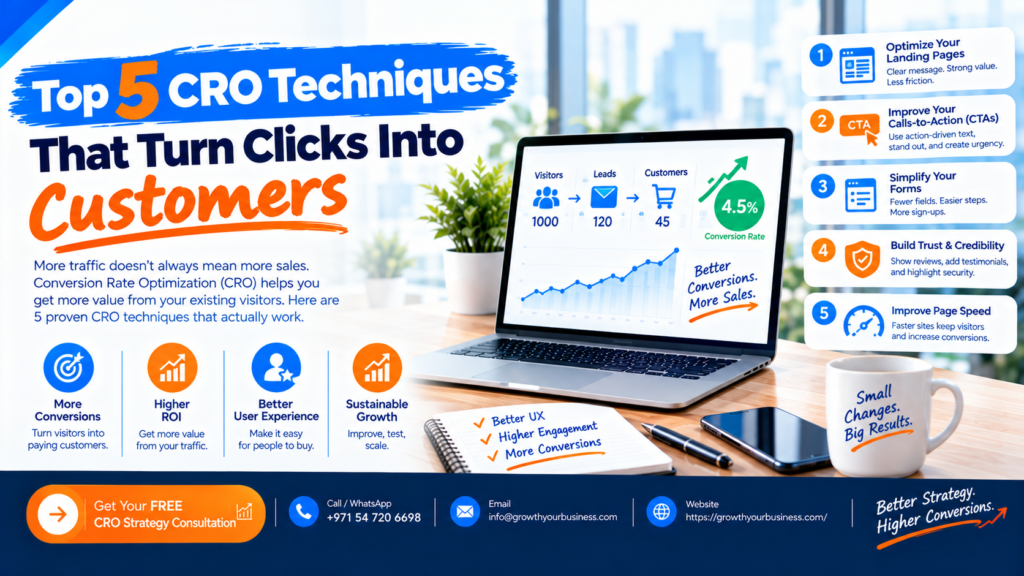
Top 5 CRO Techniques That Turn Clicks Into Customers
CRO techniques are methods that increase the percentage of website visitors who take a valuable action, such as booking a call, filling in a form or buying. The five that matter most are: make your offer clear above the fold, speed up your pages, build trust at the point of decision, simplify forms and checkout, and test changes one at a time. Because CRO improves results from the traffic you already have, it often lowers your cost per lead without raising your ad budget.
Updated October 2026 by the Growth Your Business team. We run Google Ads and Meta Ads campaigns and optimise the landing pages behind them.
What Is CRO and Why Does It Matter?
Conversion rate optimisation (CRO) is the process of improving your website so more visitors become leads or customers.
Here is why it matters for paid traffic. If 100 clicks cost £200 and 2 people enquire, each lead costs £100. If better CRO techniques lift that to 4 enquiries, each lead costs £50, with no extra spend. Every pound of ad budget works harder.
Our conversion rate optimisation service is built around exactly this idea.
Technique 1: How Do You Make Your Offer Clear in 5 Seconds?
Visitors decide very quickly whether a page is relevant. Your top section (above the fold) should answer three questions immediately:
- What do you offer?
- Who is it for?
- What should I do next?
How to apply it:
- Make the headline match the ad the visitor clicked. If the ad said “Google Ads for Plumbers,” the page should say the same.
- Add one clear benefit-led subheading under the headline.
- Show one primary button (“Get a Free Audit”) instead of five competing options.
A mismatch between ad and landing page is one of the most common reasons paid traffic fails to convert.
Technique 2: How Does Page Speed Affect Conversions?
Slow pages lose visitors before they see your offer, especially on mobile, where most ad clicks come from.
How to apply it:
- Test your page with Google PageSpeed Insights.
- Compress images and use modern formats like WebP.
- Remove unused plugins and scripts (common on WordPress and Elementor sites).
- Use a caching plugin and a good host.
- Make sure buttons and forms work smoothly on a phone.
Speed also helps your Google Ads Quality Score and your SEO.
Technique 3: How Do You Build Trust to Increase Conversions?
People hesitate when they’re unsure whether you’re credible. Reduce that doubt right where they decide.
How to apply it:
- Place reviews and testimonials near your button and form.
- Show client logos, certifications or awards you genuinely hold.
- Add real names, photos and contact details, not just a form.
- Include a short guarantee or “what happens next” line, such as “We reply within 1 business day.”
- Link to a clear privacy policy.
Only use claims you can prove. Unverifiable “best” or “guaranteed” statements can break advertising rules and damage trust.
Technique 4: Why Should You Simplify Forms and Checkout?
Every extra field is a reason to leave.
How to apply it:
- Ask only for what you need to follow up (usually name, phone or email, and a short message).
- Use clear field labels and a specific button label (“Get My Free Audit” beats “Submit”).
- Offer alternatives such as click-to-call and WhatsApp for people who hate forms.
- For e-commerce, enable guest checkout and show shipping costs early.
- Fix error messages so people know exactly what to correct.
Be careful not to remove fields your sales team genuinely needs to qualify leads. A shorter form with poor leads isn’t a win.
Technique 5: How Do You Use Testing to Improve Conversions?
Guessing is the opposite of CRO. Testing shows what actually works for your audience.
How to apply it:
- Change one thing at a time (headline, button text, image, form length) so you know what caused the result.
- Run each test long enough to gather meaningful data. Judging after two days usually misleads you.
- Use heatmaps and session recordings (for example, Microsoft Clarity, which is free) to see where visitors get stuck.
- Record what you test and learn, so you don’t repeat failed ideas.
Accurate testing depends on accurate tracking, so set up GA4 and Google Tag Manager correctly first.
How Do You Measure Whether CRO Is Working?
Track these numbers before and after every change:
| Metric | What it tells you |
|---|---|
| Conversion rate | Share of visitors who take your target action |
| Cost per lead / acquisition | What each result costs you |
| Bounce or engagement rate | Whether visitors find the page relevant |
| Form completion rate | Where people drop off in your form |
| Lead quality | Whether leads become paying customers |
A Looker Studio dashboard can show these alongside your Google Ads and Meta Ads data in one live report.
Common CRO Mistakes to Avoid
- Sending ad traffic to the homepage instead of a focused landing page
- Testing many changes at once
- Stopping a test too early
- Optimising for form fills while ignoring lead quality
- Ignoring mobile users
- Copying a competitor’s page without testing it on your own audience
- Fixing conversion rate before fixing tracking
Frequently Asked Questions
What are CRO techniques?
CRO techniques are methods for increasing the percentage of visitors who complete a valuable action. Common ones include clearer messaging, faster pages, stronger trust signals, simpler forms and structured testing.
How long does CRO take to show results?
Some fixes, such as speeding up a page or correcting a message mismatch, can help quickly. Testing-based improvements typically need several weeks of data to be reliable.
What is a good conversion rate?
It depends heavily on your industry, offer and traffic source. Rather than chasing a universal benchmark, compare against your own past performance and improve steadily.
Is CRO better than getting more traffic?
They work together. More traffic to a page that doesn’t convert wastes money, while CRO makes every visitor, paid or organic, more valuable.
Do I need a lot of traffic to do CRO?
Meaningful A/B tests need enough visitors to be reliable. With lower traffic, focus on proven fixes (clarity, speed, trust, shorter forms) and use heatmaps and recordings rather than formal split tests.
What tools do I need for CRO?
At minimum: GA4 for measurement, Tag Manager for tracking events, a heatmap tool such as Microsoft Clarity, and a way to build and test page variations.
How does CRO help Google Ads and Meta Ads?
A higher conversion rate lowers your cost per lead and gives ad algorithms better signals, so the same budget produces more customers.
Final Thoughts
The best CRO techniques aren’t tricks. They make it easier for the right visitor to understand your offer, trust you and take the next step. Start with clarity, speed and trust, then simplify your forms and test steadily. Small improvements compound, and every gain makes your ad spend more efficient.
Want More Customers From the Clicks You Already Pay For?
Growth Your Business audits your landing pages, tracking and campaigns to find where leads are being lost, then fixes them. Learn more about our CRO service, or see how we run campaigns through our PPC agency and Meta Ads agency teams.
Get Your Free CRO Audit →
Prefer to talk? Book a free 30-minute consultation.